



Inserts and Connections for Precast Concrete: Types, Applications, and Selection Guide
Precast concrete construction depends on precisely planned interfaces. Every wall panel, beam, stair unit, and equipment mounting point must connect to another element safely, efficiently, and with minimal rework. Cast-in inserts and connections create these interfaces before the concrete is poured. They allow bolts, rods, brackets, plates, and structural members to be attached at predetermined locations, reducing on-site drilling and improving installation accuracy.
What Are Precast Concrete Inserts and Connections?
Inserts and connections are embedded components that remain integrated with a precast element after curing. An insert commonly provides a threaded or looped fixing point; a connection component transfers forces between concrete and steel, or between separate concrete elements. Their performance depends on the complete system: insert geometry, material, embedment, concrete strength, reinforcement, edge distance, connected hardware, and installation conditions.
No product should be selected from a catalogue name alone. Final selection must follow project drawings, engineering calculations, applicable standards, and the manufacturer’s instructions.
Main Products for Inserts and Connections
Ferrule Loop Insert Coil Inserts for Concrete
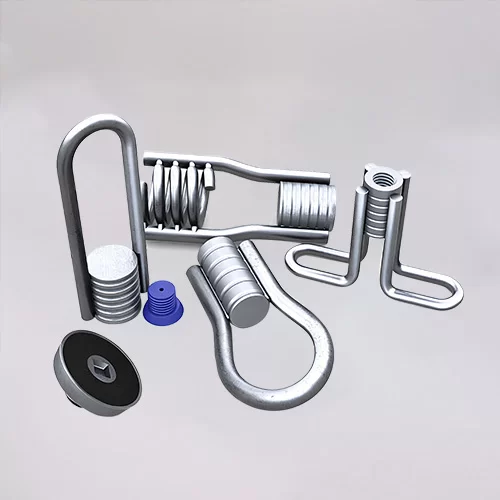
Ferrule loop inserts combine a threaded ferrule with a welded wire loop. The threaded opening provides a fixing point for bolts or rods, while the loop anchors the assembly within the concrete. A flared ring can reduce the required embedment depth and help limit interference with reinforcement in congested sections. The design is suitable for precast wall panels, structural attachments, and general fixing applications where reliable tension and shear load transfer is required.
Installation accuracy is critical. The insert should be positioned at the specified angle and embedment depth, with the threaded opening aligned to the form face as required. Threads must remain clean and protected during casting. Load capacity should always be taken from the approved product data for the specified concrete strength and geometry.
Coil Loop Insert
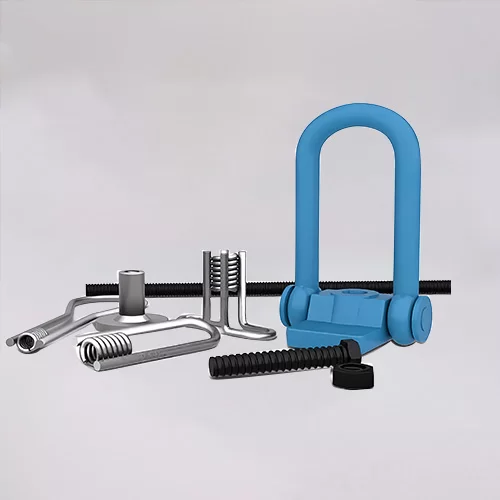
Coil Loop Insert is a broad product family rather than a single fixed design. Standard, thin-slab, flared, expanded, and other coil configurations may be used for structural connections, anchoring, bracing, and support of pipes or mechanical equipment. Coil threads can clear quickly after casting, which helps maintain a usable fixing point when protection and cleaning procedures are followed. The insert is commonly supplied in carbon steel with plain or galvanized finishes, with other materials and coatings available for project requirements.
Because coil-loop designs differ in wire diameter, coil pitch, body length, and end geometry, safe working loads cannot be transferred from one model to another. Capacity, edge distance, and corner distance must be confirmed against the relevant model table and design conditions. Coil loop inserts are mainly intended for fixing, anchoring, and connection; they should not be treated as lifting anchors unless the product is specifically designed, rated, and approved for that function.
Coil Straight Loop Insert
A Coil Straight Loop Insert is manufactured by welding a wire loop to a steel ferrule, generally produced from bar stock. One end is closed, while the opposite end is drilled and tapped to accept a compatible threaded bolt. The closed back helps prevent concrete from entering the internal thread. A mounting washer can allow the insert to be secured to the form during production.
This design is useful in thinner precast elements or locations where a longer insert cannot be accommodated. Typical applications include wall-panel connections, structural attachments, and other cast-in fixing points. During selection, confirm thread size and pitch, bolt engagement, insert height, loop projection, minimum edge and corner distances, and the required placement relative to reinforcement. The loop must not be altered to fit the mold or surrounding steelwork without technical approval.
Embedment Plates Precast Concrete Steel Embed Plates
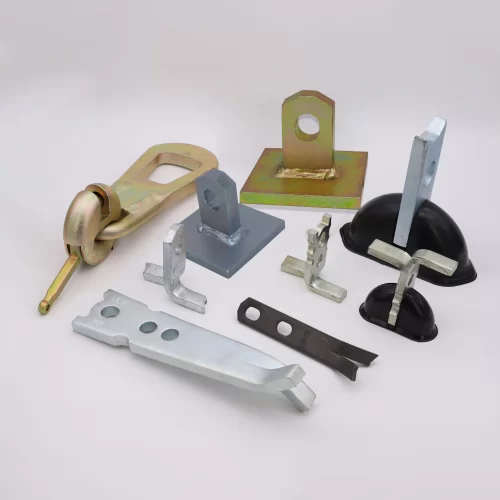
Steel embed plates provide a direct interface between concrete and steel components. A plate is fitted with welded anchors or headed studs and is cast into a panel, slab, beam, or other precast unit. Once exposed, the plate can receive structural steel frames, facade or curtain-wall supports, elevator guides, prefabricated stairs, and other connection assemblies. The system may transfer tension, shear, or combined loads, depending on the engineered design.
Production control covers plate size and thickness, anchor diameter and length, weld quality, stud spacing, flatness, protective treatment, and position in the form. Before casting, the specification, quantity, and dimensions should be checked. The vibrator should not strike the mounting frame, concrete should not be directed against connection parts, and exposed threads must be protected. After casting, position and deviation should be recorded and reviewed against the permitted tolerance.
Coil Loop Insert Precast Concrete Straight Loop Coils
Coil Loop Insert Precast Concrete Straight Loop Coils is a descriptive name for a straight-loop coil insert used to create an embedded fixing, anchoring, or connection point in precast concrete. The coil or threaded section accepts compatible fixing hardware, while the loop structure anchors the assembly in the element. It is used in wall panels, slabs, beams, and other applications where prepared connection points are preferable to post-cure drilling.
This product name overlaps closely with the coil straight loop insert category. Buyers should therefore compare the actual drawing, thread specification, loop shape, insert length, wire diameter, and load data rather than assume that different catalogue names represent different products. Material options may include carbon steel, alloy steel, or stainless steel, with galvanized, powder-coated, painted, or other finishes selected for durability and the service environment.
How the Components Work in Precast Production
The process begins with coordinated design: the insert type, position, material, and embedment are matched to the load path, concrete section, reinforcement, and connected hardware. During production, the insert or plate is fixed accurately in the mold and protected from displacement and concrete ingress. Concrete is placed and cured according to the approved procedure, after which the element is demolded and inspected. On site, compatible bolts, rods, brackets, or steel members are installed to the embedded interface.
This sequence explains why the component cannot be evaluated in isolation. A sound insert can still perform poorly if it is misplaced, rotated, embedded in the wrong concrete section, obstructed by reinforcement, or connected with incompatible hardware.
How to Select the Right Insert or Connection
Start with the application and load direction. Confirm whether the connection must resist tension, shear, or combined forces, and identify the structural or non-structural nature of the application. Next, review concrete strength, element thickness, edge and corner distances, reinforcement congestion, and casting orientation. Check the thread or steel interface against the proposed bolt, rod, bracket, or welded assembly, including required engagement.
The service environment determines material and coating requirements. Review corrosion exposure, moisture, chemicals, temperature, expected service life, and maintenance access. Finally, request dimensional data, material information, inspection records, and approved load tables for the exact model. For structural applications, a qualified engineer should verify the complete connection rather than rely solely on supplier catalogue values.
Typical Applications
Common applications include precast wall-panel connections, steel-to-concrete interfaces, facade support systems, elevator guides, prefabricated stairs, equipment and bracket mounting, and pipe or service supports. Threaded and coil inserts support removable or permanent fixings, while embedment plates are normally chosen when a steel member or fabricated assembly must connect to the concrete face. Correct detailing at the design stage reduces field modifications and keeps interfaces compatible across production and installation.
Why Choose HULK Metal?
HULK Metal supplies precast concrete coil inserts, ferrule inserts, steel embed plates, and related fixing components for standard and project-specific requirements. The product range covers the main interface types discussed in this guide, allowing customers to coordinate multiple accessories through one manufacturing partner.
Customers can submit drawings, samples, thread requirements, dimensions, materials, surface treatments, quantities, and application details for evaluation. HULK Metal’s OEM service supports casting, forging, stamping, welding, and CNC machining, enabling the production plan to follow the component design rather than forcing every project into a standard catalogue item. Engineering review also helps clarify feasible materials, finishes, and manufacturing details before order confirmation.
Quality planning can cover incoming material checks, dimensional and thread inspection, weld and surface review, mechanical or performance testing where required, and final quantity checks. HULK Metal operates under an ISO 9001 quality management system and maintains inspection equipment for dimensional, material, hardness, impact, tensile, and corrosion testing. Product-specific certifications and test reports should be confirmed for the exact item and destination market before ordering.
The supply chain extends from production control through protective packaging and freight consultation. Clear specification review at the quotation stage helps reduce compatibility errors, unnecessary variants, and avoidable resubmission later. Customers should provide final drawings and applicable standards so that the quotation reflects the actual project requirement.
Successful precast connections begin long before site installation. Choosing the correct insert or embed plate, controlling its position during casting, and verifying compatibility with the connected hardware all contribute to efficient production and dependable assembly. For project-specific inserts, plates, and connection accessories, HULK Metal offers drawing-based manufacturing support and quality planning from quotation through delivery.
Article Navigation
PRECAST CONCRETE ACCESSORIES
OTHER RELATED ARTICLE
Other Precast Concrete Accessories You Might Want to Know
You can click to learn more about HULK Metal precast concrete accessories such as lifting anchors, precast sockets, spread anchors, shuttering magnets, cast-in channels, wire loop boxes, and other precast concrete accessories you might want to know.