



How to Choose Lifting Foot Anchors for Heavy Precast Elements?
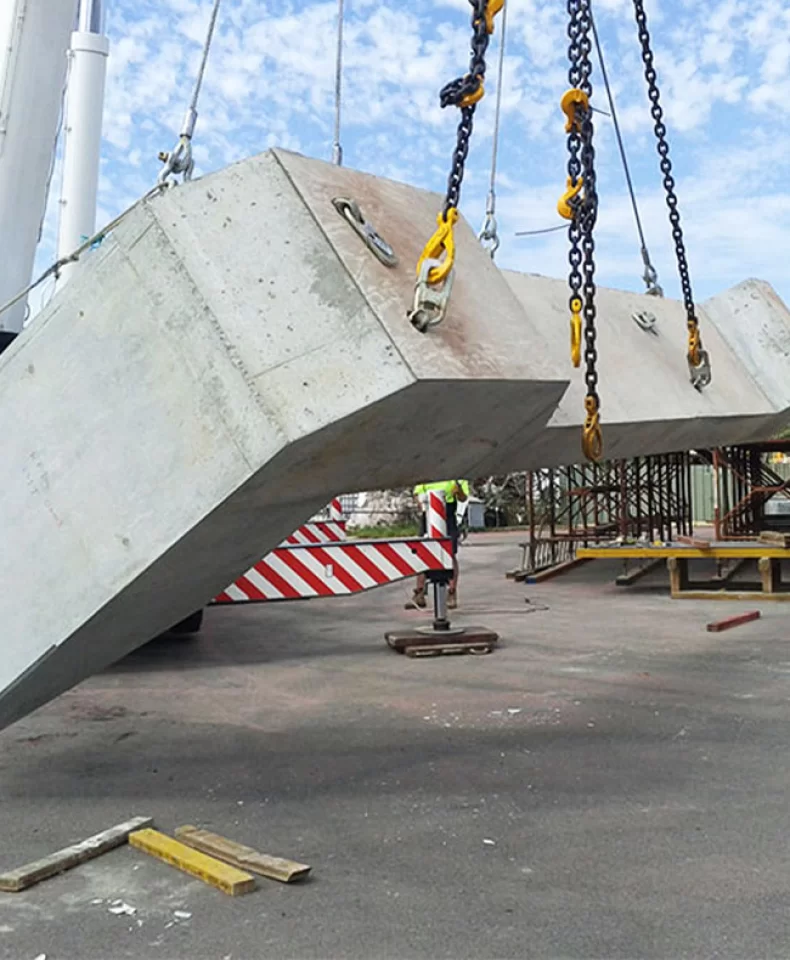
Precast concrete wall panels, beams, columns, double-tee slabs, and other large elements are handled repeatedly throughout their life cycle. They are lifted from the casting bed, stripped from the formwork, tilted, stacked, loaded for transport, unloaded, and lifted into position on site. Each of those operations depends on a single interface between a multi-tonne element and the crane: the lifting anchor.
Heavy elements are not simply heavier versions of light ones. Their mass generates high tensile and shear demands at each lifting point, concentrated into a small volume of concrete around the anchorage. When an anchor is undersized, positioned incorrectly, or embedded in concrete that has not reached sufficient strength, the failure mode is often the surrounding concrete rather than the fitting itself.
Lifting foot anchors are designed for this class of application. They provide a robust, cast-in connection point that transfers large lifting loads into the body of an element and remains stable under the dynamic effects of real handling operations. Anchoring therefore affects both production efficiency and the safety of everyone working around the lift.
What Is a Lifting Foot Anchor?
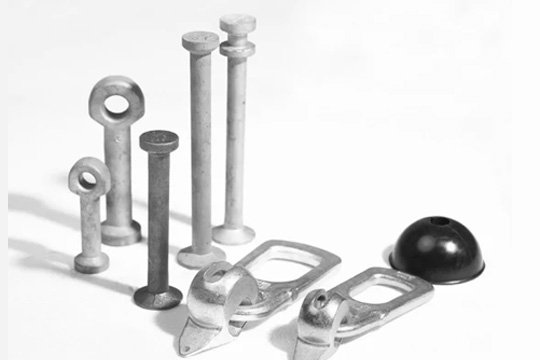
A lifting foot anchor is a cast-in steel anchorage whose lower end — the "foot" — is embedded in the concrete element during casting, while its upper part remains accessible to a compatible lifting clutch or lifting device. Once the concrete has cured, the anchor becomes a permanent, integral connection point within the element.
The principle is straightforward. Rather than fixing a temporary device to the surface, the anchor distributes the lifting force into the concrete along its embedded length, and the foot geometry resists pull-out. Because the anchor stays permanently in the element, the same lifting point is reused during demolding, transport, and final installation — one reason foot anchors suit heavy elements well.
The distinction from general-purpose lifting anchors lies in application and load path. Where a spherical head or flat anchor is often chosen for lighter or space-constrained elements, a lifting foot anchor is chosen when load capacity and secure anchorage into a substantial concrete section are the primary requirements.
Why Are Lifting Foot Anchors Important for Heavy Lifting?
Designed to Transfer High Lifting Loads
The task of a lifting anchor is not simply to resist a force, but to pass it into the concrete in a controlled way. A well-designed foot anchor spreads the applied load over a defined embedment length and reduces the local stress concentrations that would otherwise build up around a small contact area. Capacity must be matched to the element weight, the number of lifting points, and the lifting method.
Improve Stability During Lifting and Handling
Elements are rarely lifted in a perfectly static condition. Acceleration and deceleration of the crane, wind, swinging, and the inherent asymmetry of the component all introduce dynamic effects that exceed its nominal dead weight. A correctly arranged set of anchors supports balance and control during tilting, turning, and repositioning. Where several anchors share a load, distribution and lifting angle must be assessed together with each point's capacity.
Reduce the Risk of Local Concrete Damage
Not every lifting incident originates in the fitting. Spalling, cracking, and pull-out can occur in the concrete surrounding an anchor when embedment depth, concrete strength, edge distance, or reinforcement detailing are inadequate for the applied load. Lifting hardware cannot be specified in isolation: anchor selection must be coordinated with the design of the element into which it will be cast.
Key Factors When Selecting Lifting Foot Anchors
Load Capacity
Capacity must be matched to the real weight of the element and to the way it will be lifted. Static weight alone is an incomplete basis, because dynamic effects during handling can raise the effective load at a lifting point above its simple share of the component's mass.
Concrete Strength
The performance of any cast-in anchor is limited by the concrete surrounding it. Lifting an element before it has reached the specified strength for handling increases the risk of anchorage failure, which is why strength verification forms part of the standard lifting sequence.
Anchor Position and Embedment
Where an anchor sits within an element affects how load is transferred. Edge distance, embedment depth, and the position of internal reinforcement all influence behaviour and should follow the engineering design rather than site convenience.
Lifting Angle and Load Distribution
Changes in lifting angle alter the force actually imposed on each anchor, particularly the component acting outside the designed load direction. When several lifting foot anchors work together, loads should be distributed as the lifting plan intends rather than assumed to be equal.
The purpose of this comparison is not to rank systems. Each has a legitimate role in precast production, and the right choice depends on the element, the lifting method, and the available depth and space. Lifting foot anchors are particularly suitable when heavy lifting loads and secure anchorage are the primary requirements.
Where Are Lifting Foot Anchors Commonly Used?
Heavy precast wall panels
Precast beams
Columns
Large concrete slabs
Bridge components
Infrastructure components
Large custom precast elements
What these elements share is a demanding handling sequence. Each passes through casting, demolding, lifting, transportation, and installation, often with interim movements in the storage yard. The anchor must remain a reliable lifting connection across that entire sequence, not merely at final erection. In bridge and infrastructure work, heavier individual loads and tighter tolerances place additional weight on accurate selection and consistent production quality.
How to Use Lifting Foot Anchors Safely
Safe lifting depends as much on procedure as on hardware. The following steps represent good practice throughout a precast lifting operation:
1. Confirm the weight of the precast element.
2. Select the appropriate anchor capacity.
3. Check concrete strength before lifting.
4. Follow the specified embedment depth.
5. Maintain the required edge distance.
6. Position anchors according to the engineering design.
7. Use compatible lifting devices.
8. Inspect anchors and lifting equipment before use.
9. Avoid exceeding the rated working load.
10. Keep personnel away from suspended loads.
One principle deserves emphasis: lifting anchor capacity cannot be evaluated independently from the concrete element and the lifting configuration. An anchor that performs correctly in one element may be unsuitable in another of similar weight if the embedment, edge distance, concrete strength, or lifting geometry differs. Capacity belongs to the complete system, not to the fitting alone.
Quality Control of Lifting Foot Anchors
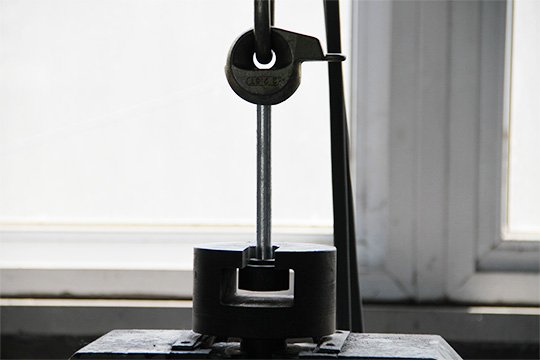
Because lifting anchors carry a safety function, production quality is a technical requirement rather than a marketing claim. A conscientious supplier should be able to document its control measures across the manufacturing process:
Raw material inspection
Dimensional inspection
Tensile strength testing
Load testing
Surface inspection
Welding inspection where applicable
Traceability of production batches
Certification and inspection documentation
These measures matter because the failure of an anchor cannot be compensated for elsewhere in the lifting system. Batch traceability links a specific delivery back to its inspection records, which is valuable both in routine quality assurance and in any investigation following an incident.
Why Choose HULK Metal for Lifting Foot Anchors?
HULK Metal supplies precast concrete accessories with a focus on lifting applications, supporting customers from initial specification through to repeat production orders:
- Professional precast concrete accessory supplier
- Multiple lifting anchor configurations and load capacities
- Custom dimensions and specifications
- Engineering support for different precast applications
- Quality inspection and traceable production
- Support for OEM and custom orders
- Complete precast lifting accessory supply
What matters to buyers is not the length of the catalogue but the way it is applied. Rather than offering one anchor type as a general solution, HULK works around the customer's precast design, load requirement, and lifting method to identify a matching anchoring solution. The same approach covers the surrounding accessories, so anchors, lifting clutches, and related components are specified as a compatible system.
Lifting foot anchors occupy a small part of a precast element but carry a disproportionate share of the risk. They are the interface through which the entire weight of a heavy component passes to the crane — repeatedly, under dynamic conditions, and often in demanding site environments. For heavy wall panels, beams, columns, slabs, bridge elements, and custom components, that combination of high load and repeated handling makes secure anchorage a design requirement rather than an optional refinement.
Equally important is the recognition that no anchor performs in isolation. Correct capacity, adequate embedment, verified concrete strength, appropriate edge distance, and a considered lifting configuration are all necessary conditions for a safe lift.
Looking for reliable lifting foot anchors for heavy precast applications? Contact HULK Metal to discuss your lifting requirements and find a suitable anchoring solution for your project.
Article Navigation
PRECAST CONCRETE ACCESSORIES
OTHER RELATED ARTICLE
Other Precast Concrete Accessories You Might Want to Know
You can click to learn more about HULK Metal precast concrete accessories such as lifting anchors, precast sockets, spread anchors, shuttering magnets, cast-in channels, wire loop boxes, and other precast concrete accessories you might want to know.