



How to Choose the Right Cast in Channel Manufacturer: A Practical Guide for Buyers
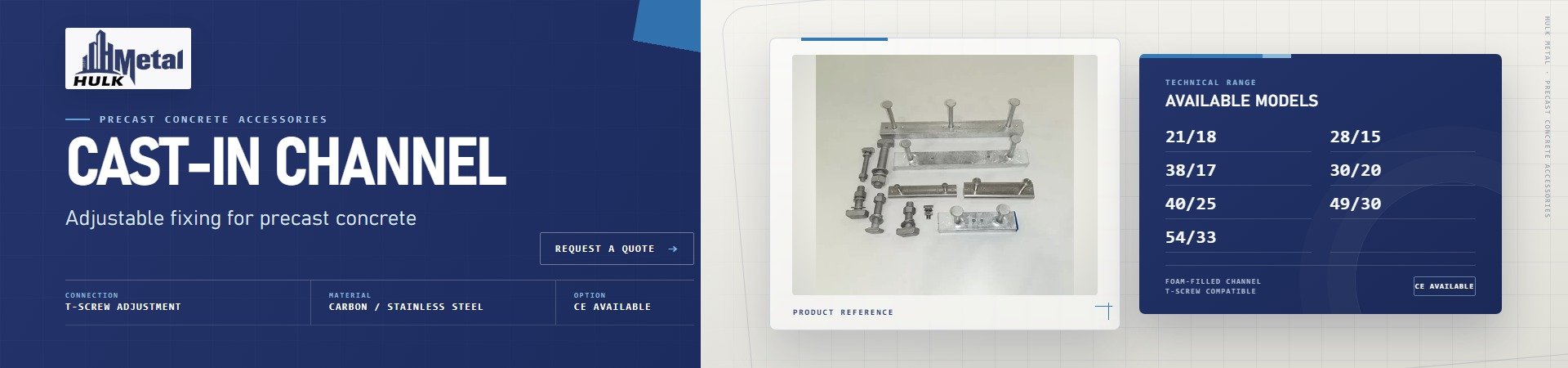
Cast-in channels are among the least visible yet most consequential components in a precast concrete structure. Embedded during casting, they form a continuous, adjustable anchoring line that allows façade panels, curtain wall brackets, structural supports, and MEP fixtures to be fixed quickly and accurately once the element reaches site. Because they are cast in, they cannot be replaced afterwards without significant cost and disruption.
That permanence makes the choice of a cast in channel manufacturer a long-term decision. Buyers routinely face familiar problems: dimensional inconsistency between batches, anchors that do not match the specified geometry, coatings that fail prematurely, and deliveries arriving after the precast production slot has passed. Each one converts into rework, delayed erection, or a quality dispute at the worst possible moment.
A qualified manufacturer helps installation proceed without on-site modification and keeps connections performing as the engineer intended. Buyers should therefore evaluate a defined set of factors before committing: technical expertise, production capability, quality control, delivery reliability, total procurement cost, and after-sales support.
Understand Your Project Requirements Before Selecting a Manufacturer
Define the Application and Load Requirements
Start with the application. Cast-in channels for precast concrete serve façade panel restraint, curtain wall brackets, structural supports, lift guide rails, tunnel services, and MEP installations — each imposing different demands on the channel, anchors, and surrounding concrete.
Clarify load capacity and load direction. Tension perpendicular to the channel axis, shear along it, and combined loading all load the anchors and channel lips differently. Connection conditions matter too: edge distance, concrete strength at loading, reinforcement congestion, and whether loads are static, dynamic, or fatigue-relevant. Confirm the applicable standards and project specifications before approaching suppliers, so every quotation is measured against the same baseline.
Select the Appropriate Channel Type and Dimensions
Toothed channels provide positive mechanical interlock with matching serrated T-bolts and are typically specified where slip resistance is critical. Plain channels suit applications favouring adjustability and simpler hardware.
Evaluate channel length, cross-section, anchor spacing, and embedded depth together. Anchor pitch governs how load transfers into the concrete; embedment depth affects both capacity and the practical risk of interfering with reinforcement or the mould face. Confirm compatibility with the specified bolts, brackets, and hardware — a well-made channel is of little use if the T-bolt head does not seat correctly in the lip geometry.
Determine Material and Corrosion Protection Requirements
Material selection follows the exposure environment. Carbon steel offers strength and cost efficiency for dry interior conditions. Stainless steel cast-in channels are specified for exterior façades, coastal sites, tunnels, pool environments, and areas exposed to de-icing salts or chemicals, where service life outweighs higher initial cost.
Where carbon steel is used, consider hot-dip galvanizing or other specified treatments, and confirm coating thickness and coverage. Assess real exposure — moisture, chlorides, chemical contact, and condensation inside the channel cavity, where water can collect unseen. Discuss end caps, channel fill, and sealing at specification stage, not after delivery.
Evaluate the Manufacturer's Technical Expertise and Production Capabilities
Experience in Cast-in Channel Manufacturing
Choose a cast-in channel supplier with demonstrable experience in precast concrete accessories and structural connection products. That experience shows in the details: understanding of embedded anchor behaviour, awareness of casting tolerances inside a precast mould, and knowledge of how channels are handled during demoulding, storage, and transport.
Request project references relevant to your application, along with technical data sheets and typical detail drawings. A supplier that can explain *why* a given anchor arrangement suits your load case adds engineering value; one that only confirms it can "follow the drawing" does not.
Manufacturing Processes and Equipment
Examine the production route: profile forming, cutting to length, anchor fabrication, anchor welding, machining where required, and surface treatment. Each step can introduce dimensional variation if left uncontrolled.
Verify that equipment and process control deliver consistent dimensions across batches — particularly on anchor pitch, channel straightness, and lip geometry, all of which affect site fit-up. Assess whether the manufacturer offers only a fixed catalogue or can also produce custom cast-in channels with non-standard sections, lengths, or anchor configurations.
Customization and Engineering Support
Most projects deviate at least partly from catalogue items. Confirm the supplier can manufacture directly from your drawings and technical specifications, and clarify how pre-production review is handled.
A capable manufacturer reviews dimensions, material grades, anchor arrangements, and connection requirements, and raises questions where a detail is impractical to produce or likely to underperform. Ensure any revision is confirmed in writing before production begins.
Verify Product Quality and Compliance with Relevant Standards
Effective cast-in channel quality control should be verified at three levels: incoming material, in-process welding and dimensional accuracy, and final testing and documentation.
Raw Material Traceability
Quality begins with the steel. Request material certificates, confirmed grades, and a description of incoming inspection covering both the channel strip and the anchor material. Confirm that what is supplied matches the approved specification — grade, mechanical properties, and dimensions. Ask whether batches can be traced from raw coil or bar through to finished goods; traceability contains a problem to one batch rather than an entire delivery.
Welding Quality and Dimensional Accuracy
Anchor welding is critical. Review the welding procedure, welder qualification, and the inspection applied to welded anchors. Welds must deliver consistent strength without distorting channel geometry or compromising the coating applied afterwards. Check how dimensions, anchor position and pitch, straightness, and lip profile are controlled — and ask for inspection records rather than general statements.
Testing, Inspection, and Certification
Request relevant quality management certifications and compliance documents, along with dimensional inspection records, material test reports, and applicable load-test reports. Confirm that test methods and acceptance criteria match your product design and project requirements, not merely a generic protocol.
Key point: Do not evaluate a cast-in channel manufacturer solely by its certificates. A certificate confirms that a system exists, not that it was applied to your order. Verify whether actual manufacturing controls and test records support the performance your application requires.
Assess Production Capacity and Delivery Reliability
Production Capacity and Order Flexibility
Confirm the supplier can handle prototype and sample orders, small trial batches, and full-volume production, and can absorb peak demand without degrading quality. Ask whether schedules can be adjusted if your programme shifts, and what notice applies.
Lead Times and Delivery Management
Confirm in writing: sample approval time, tooling or preparation time, production lead time, and estimated shipping schedule. Assess how procurement, planning, packaging, and transport are managed, and how delays are communicated — early notification with a mitigation plan is worth far more than a report issued after the delivery date has passed.
Supply Chain Stability
Examine access to reliable raw material sources and surface treatment providers. Where processes such as galvanizing are outsourced, assess the controls applied at the subcontractor and the verification performed on return. Confirm contingency plans for material shortages, equipment breakdown, or logistics disruption.
Compare Total Procurement Costs Instead of Unit Prices Alone
Understand the Main Cost Components
A quotation reflects several drivers: material grade and consumption; channel dimensions, anchor configuration, and customization; welding, machining, and surface treatment; and inspection, packaging, transport, and other agreed services. This breakdown shows where cost can be reduced without compromising performance.
Evaluate Long-Term Cost Efficiency
Dimensional inconsistency and defects cost far more than the parts themselves. Channels that do not fit the mould or hardware cause rework at the plant; rejected batches trigger replacement orders and schedule slippage; a failed connection discovered on site can delay an entire erection sequence. Compare suppliers on overall value, quality consistency, and delivery performance rather than price alone.
Request a Clear and Comparable Quotation
Give every candidate identical drawings, specifications, quantities, and inspection requirements. Request an itemized breakdown of unit price, tooling charges, lead time, and shipping terms, and confirm validity plus the procedure for handling specification changes.
Examine Customer Service and After-Sales Support
Communication and Technical Response
Assess response speed and the clarity of technical explanations during enquiry — usually a reliable indicator of performance during production. Confirm the supplier provides timely updates during sampling and manufacturing, and can coordinate with both engineering and procurement teams.
Packaging and Product Protection
Review packaging methods. Channels, anchors, and coated surfaces must be protected against impact, moisture, and abrasion in transit, especially for long lengths and galvanized or stainless finishes. Confirm product identification, labelling, and batch traceability where required.
Quality Issue Resolution
Clarify before ordering how nonconforming products, shortages, and delivery discrepancies are handled, whether replacements or supplementary deliveries are available under agreed terms, and whether documented corrective measures will be provided.
Common Mistakes to Avoid When Choosing a Cast-in Channel Manufacturer
- Selecting a supplier based on price without verifying technical capability.
- Overlooking anchor geometry, load requirements, and hardware compatibility.
- Assuming a general quality certificate guarantees compliance with project specifications.
- Skipping sample approval or failing to agree inspection criteria before mass production.
- Ignoring delivery capacity, packaging, and after-sales arrangements.
- Comparing quotations built on different materials, coatings, or acceptance criteria.
Cast-in Channel Manufacturer Evaluation Checklist
The following table can help procurement teams compare suppliers using consistent criteria.
Evaluation Factor | What Buyers Should Verify |
|---|---|
Technical Expertise | Relevant manufacturing experience and understanding of cast-in channel applications |
Product Customization | Ability to manufacture according to customer drawings, dimensions, and technical specifications |
Material Quality | Material certificates, steel grades, and raw material traceability |
Manufacturing Capability | Forming, welding, machining, and surface treatment capabilities |
Quality Control | Inspection procedures, dimensional accuracy, welding quality, and test reports |
Standards and Compliance | Compliance with applicable industry standards and project-specific requirements |
Production Capacity | Ability to handle sample orders, small batches, and large-volume production |
Delivery Reliability | Confirmed production lead times, delivery schedules, and logistics arrangements |
Cost Transparency | Clear quotations covering unit prices, tooling, surface treatment, packaging, and shipping |
After-Sales Support | Procedures for handling defective products, quantity shortages, replacements, and corrective actions |
Why Choose HULK Metal as Your Cast-in Channel Manufacturing Partner
HULK Metal supports contractors, precast manufacturers, and building materials distributors with precast concrete accessories and related metal components. For concrete anchor channels, we coordinate the order from drawing through to delivery:
- Manufacturing coordination — sourcing and production coordination across precast accessories and related metal components.
- Customized production — manufacture to your drawings, dimensions, material requirements, and order quantities, including stainless steel cast-in channels and custom configurations.
- Quality assurance — material verification, production inspection, and supporting documentation with each order.
- Supply chain management — coordination of material procurement, manufacturing, inspection, packaging, and logistics.
- Order support — communication throughout the order process and assistance with agreed quality and delivery issues.
Selecting a cast-in channel manufacturer is not simply a purchasing decision; it determines how reliably your structure gets built. Engineering support determines whether the product suits the application. Manufacturing capability determines consistency. Quality control determines performance. Delivery reliability determines whether your programme holds. Total procurement cost determines real value.
The right supplier demonstrates consistent performance and transparent communication, not simply a competitive price. Evaluate candidates against a common set of criteria, approve samples before volume production, and agree inspection requirements in writing.
Looking for a reliable cast-in channel manufacturing partner? Contact HULK Metal to discuss your drawings, material requirements, customization needs, and production schedule.
Article Navigation
PRECAST CONCRETE ACCESSORIES
OTHER RELATED ARTICLE
- 1.How to Choose High-Quality Shuttering Magnetic Products and Suppliers Guide
- 2.Applications and advantages of swivel hoist rings: HULK Metal provides you with safer and more flexible lifting solutions
- 3.Lifting Clutch VS Lifting Ring Clutch:Definition, Working Principle, Application Scenarios, and Selection Guide
- 4.Lifting Anchors: An Essential Component in Construction and Heavy Lifting
Other Precast Concrete Accessories You Might Want to Know
You can click to learn more about HULK Metal precast concrete accessories such as lifting anchors, precast sockets, spread anchors, shuttering magnets, cast-in channels, wire loop boxes, and other precast concrete accessories you might want to know.